
Every second, companies like Uber, Netflix, and Amazon process massive amounts of data from millions of users across the world. Whether you are booking a ride, watching a movie, or ordering a product, these platforms are continuously collecting and processing real-time information.
The reason everything feels fast and smooth is because these companies use advanced data engineering systems behind the scenes.
Modern businesses cannot wait hours to process information anymore. They need real-time data processing to make instant decisions, improve customer experience, and keep systems running efficiently.
In this blog, you will understand how companies like Uber, Netflix, and Amazon process real-time data using modern big data technologies.
What is Real-Time Data Processing?
Real-time data processing means handling data immediately as it is generated.
Instead of storing data and processing it later in batches, companies process events instantly. This helps businesses respond quickly to user actions and system changes.
Examples of real-time data include:
- Ride requests on Uber
- Movie recommendations on Netflix
- Product searches on Amazon
- Payment transactions
- Live notifications
Modern applications depend heavily on real-time systems because users expect instant responses.
How Uber Processes Real-Time Data
Uber handles millions of ride requests every day. When a user books a ride, the system must process location data, driver availability, traffic conditions, and pricing instantly.
Uber continuously processes:
- GPS location updates
- Driver movement
- Ride requests
- Estimated arrival times
- Dynamic pricing calculations
This data flows through streaming pipelines and distributed systems in real time.
If Uber used slow batch systems, ride matching and pricing would become delayed, creating poor user experience.
Real-time processing helps Uber:
- Match drivers quickly
- Optimize routes
- Reduce waiting time
- Update prices dynamically
How Netflix Uses Real-Time Data
Netflix processes huge amounts of streaming and user activity data every second.
Whenever you:
- Search for a movie
- Watch content
- Pause or skip scenes
- Rate shows
Netflix collects and analyzes this information instantly.
This helps Netflix:
- Recommend personalized content
- Improve streaming quality
- Detect buffering issues
- Understand viewing behavior
Netflix uses modern distributed systems and big data processing tools to handle this scale efficiently.
Its recommendation engine depends heavily on real-time analytics and machine learning systems.
How Amazon Uses Real-Time Data
Amazon processes real-time data to improve shopping experience and manage operations.
When you search or buy products, Amazon instantly analyzes:
- Search behavior
- Purchase history
- Product availability
- Customer preferences
- Delivery tracking
This helps Amazon provide:
- Personalized recommendations
- Real-time inventory updates
- Faster search results
- Delivery tracking systems
Real-time systems also help Amazon detect fraud and monitor transactions immediately.
Technologies Used Behind the Scenes
Companies like Uber, Netflix, and Amazon use modern data engineering technologies to process large-scale real-time data.
Some commonly used technologies include:
- Apache Spark
- Apache Kafka
- Cloud platforms like AWS
- Distributed storage systems
- Streaming pipelines
- Real-time analytics tools
These tools help process millions of events quickly and reliably.
Role of Data Pipelines
Data pipelines are one of the most important parts of real-time systems.
A pipeline continuously moves data from applications into processing systems and analytics platforms.
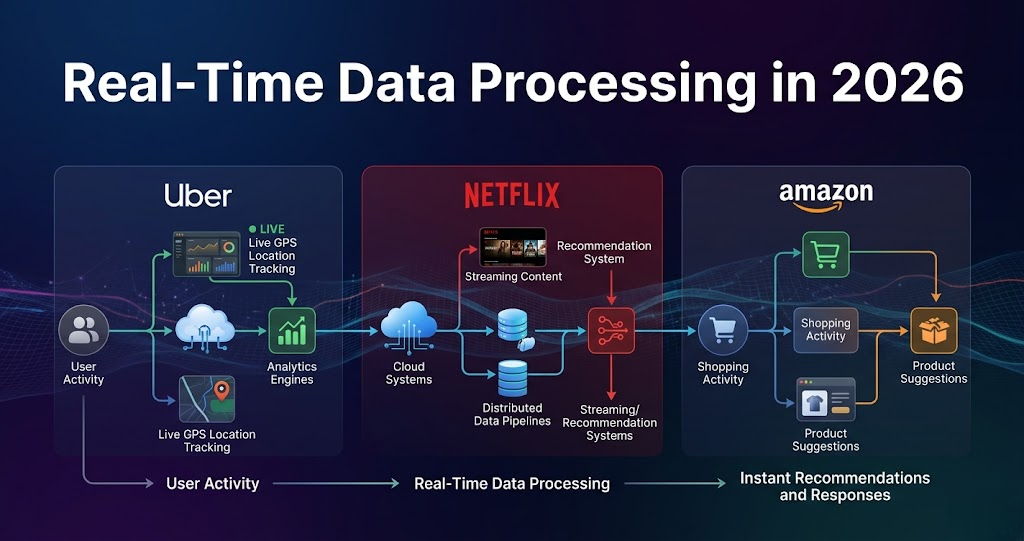
A simple flow looks like this:
User Activity → Streaming Pipeline → Real-Time Processing → Analytics → Instant Response
These pipelines help companies process and react to data immediately.
Without strong pipelines, real-time systems cannot work efficiently.
Why Real-Time Data is Important
Modern users expect fast responses from applications.
People expect:
- Instant recommendations
- Fast delivery updates
- Smooth streaming
- Quick transactions
Real-time processing helps companies improve customer experience and business performance.
It also helps businesses:
- Detect problems quickly
- Improve operational efficiency
- Make faster decisions
- Increase customer engagement
This is why real-time data processing is becoming essential in modern technology systems.
What Beginners Can Learn from This
Understanding how real-time systems work helps beginners understand the importance of modern data engineering.
Today’s data engineers work with:
- Streaming systems
- Cloud platforms
- Distributed processing tools
- Real-time pipelines
Skills like Apache Spark, Kafka, cloud computing, and data pipelines are becoming highly valuable in 2026.
Learning these technologies can open strong career opportunities in modern data companies.
Companies like Uber, Netflix, and Amazon depend heavily on real-time data processing to deliver fast and personalized experiences.
From ride matching and movie recommendations to shopping systems and analytics, modern applications rely on advanced data engineering infrastructure.
As businesses continue growing digitally, the importance of real-time data systems will continue increasing.
This is why technologies related to streaming, cloud computing, and big data processing are becoming some of the most important skills in modern data engineering careers.