

Introduction
Trying to understand Data Lake vs Data Warehouse but getting confused?
You’re not alone.
Most people:
- Hear Data Lake in cloud projects
- Hear Data Warehouse in analytics
- See both used in pipelines
But when asked the difference in real projects, they get stuck.
Because knowing definitions is not equal to understanding how data is stored and used.
In this blog, you’ll understand:
- What Data Lake is
- What Data Warehouse is
- Key differences
- When to use each
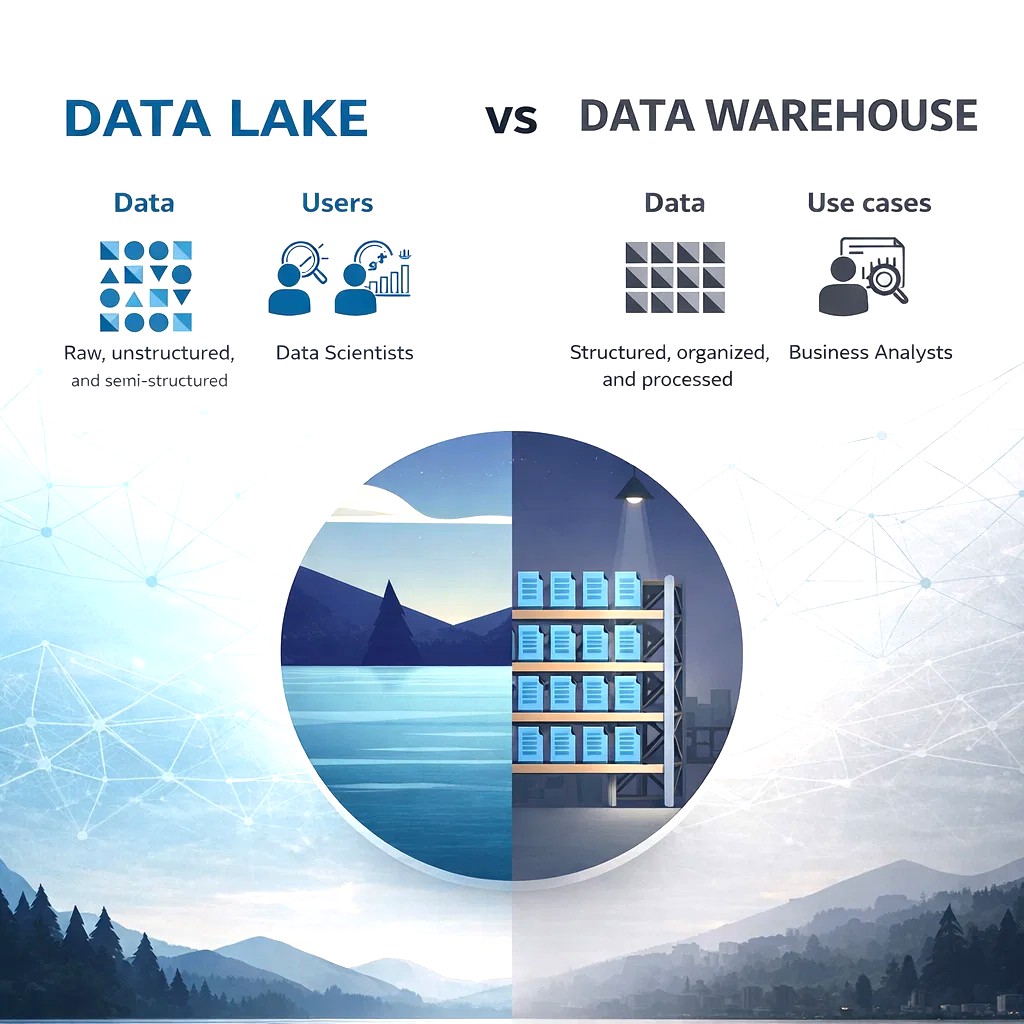
A Data Lake stores raw data, while a Data Warehouse stores processed and structured data for analytics.
What is a Data Lake?
A Data Lake is a storage system that stores data in raw format.
It stores:
- Structured data
- Semi-structured data
- Unstructured data
In simple terms:
Data Lake stores everything as it is.
Data Lake Flow
- Data comes from source
- Stored directly in raw format
- Processing happens later
Example:
API → S3 → Processing
What is a Data Warehouse?
A Data Warehouse is used to store processed and structured data.
It stores:
- Clean data
- Structured data
- Ready-to-use data
In simple terms:
Data Warehouse stores data for reporting and analytics.
Data Warehouse Flow
- Data comes from source
- Processed and cleaned
- Loaded into warehouse
Example:
API → Processing → Redshift
Data Lake vs Data Warehouse Difference
Data Lake:
- Stores raw data
- Flexible schema
- Used for processing
Data Warehouse:
- Stores processed data
- Fixed schema
- Used for analytics
Data Lake vs Data Warehouse
Data Lake:
- Raw data storage
- Schema on read
- Supports all data types
- Low cost
Data Warehouse:
- Processed data storage
- Schema on write
- Structured data only
- Higher cost
Data Lake vs Data Warehouse Example
Data Lake Example:
- Logs stored in S3
- Data processed later using Spark
Data Warehouse Example:
- Clean data loaded into Redshift
- Used for reporting
When to Use Data Lake
Use Data Lake when:
- You need to store raw data
- Handling large volumes
- Working with different data formats
When to Use Data Warehouse
Use Data Warehouse when:
- Data is structured
- Need fast queries
- Used for reporting and dashboards
Why Both are Used Together
In real projects, both are used.
Flow:
- Data stored in Data Lake
- Processed using Spark
- Loaded into Data Warehouse
- Used for analytics
Real-World Example
Retail pipeline:
- Sales data stored in Data Lake
- Processed using Spark
- Loaded into Data Warehouse
- Dashboard shows insights
Common Mistakes
- Thinking both are same
- Using Data Warehouse for raw data
- Not designing storage properly