

Introduction
Trying to choose between AWS and Azure for Data Engineering but feeling confused?
You’re not alone.
Most people:
- Start learning AWS
- Then hear Azure is also popular
- See job requirements asking for both
But when deciding which one to choose for career, they get stuck.
Because knowing tools is not equal to knowing which path is better for your career.
In this blog, you’ll understand:
- AWS vs Azure Data Engineering difference
- Career opportunities
- Job demand
- Which one to choose
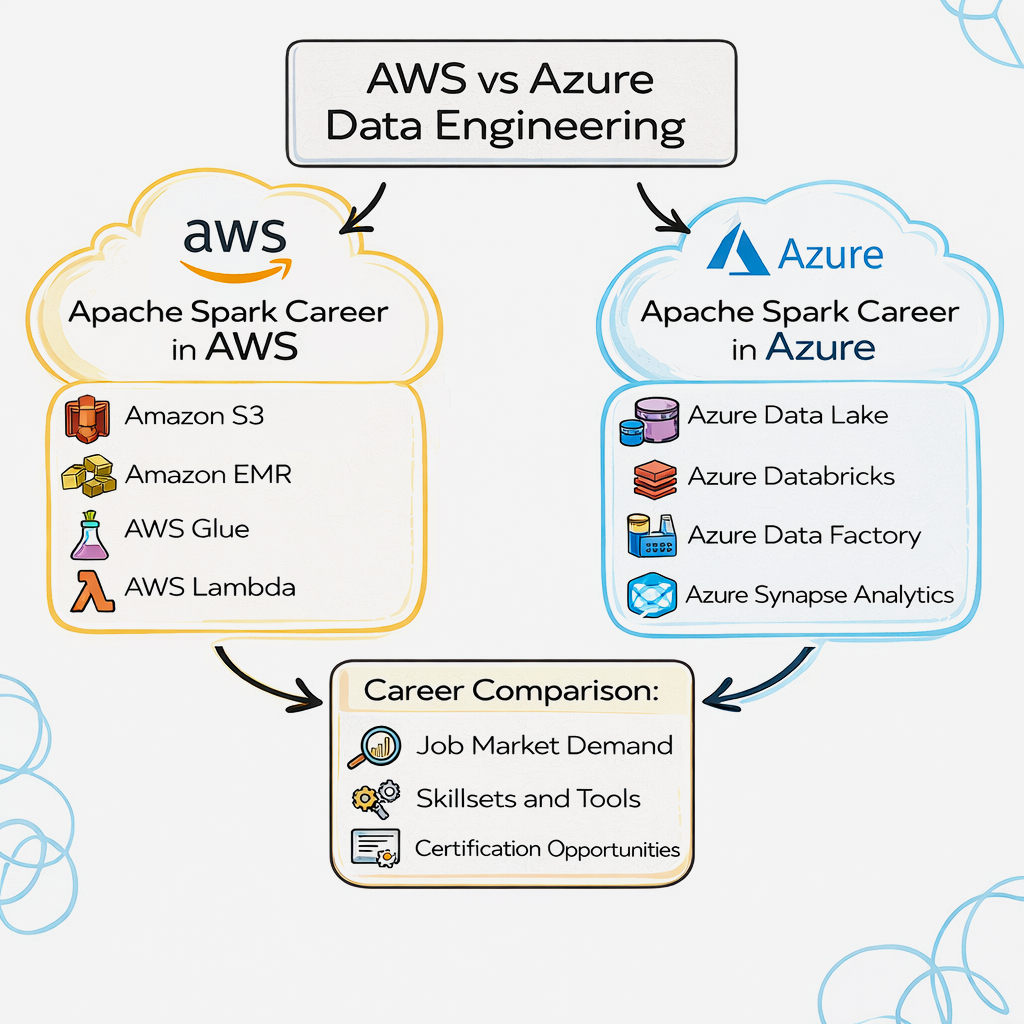
AWS and Azure both provide similar data engineering services, but AWS is more widely used, while Azure is strong in enterprise environments.
What is AWS Data Engineering?
AWS Data Engineering uses cloud services like:
- Amazon S3 (storage)
- AWS Glue (processing)
- AWS Lambda (trigger)
- Amazon Redshift (analytics)
Used for building data pipelines on AWS cloud.
What is Azure Data Engineering?
Azure Data Engineering uses services like:
- Azure Data Lake Storage
- Azure Data Factory
- Azure Databricks
- Azure Synapse Analytics
Used for building pipelines on Azure cloud.
AWS vs Azure Data Engineering Difference
AWS:
- More market adoption
- Strong ecosystem
- More job openings
Azure:
- Strong in enterprise companies
- Integrated with Microsoft tools
- Growing demand
AWS vs Azure Services Mapping
Storage:
- AWS → S3
- Azure → Data Lake
Processing:
- AWS → Glue
- Azure → Databricks
Orchestration:
- AWS → Step Functions
- Azure → Data Factory
Warehouse:
- AWS → Redshift
- Azure → Synapse
Career Opportunities
AWS:
- More job openings
- Startups and product companies
Azure:
- Enterprise companies
- Banking and corporate sectors
Salary Comparison
Both offer similar salary ranges.
Depends on:
- Experience
- Skills
- Location
No major difference in pay.
Learning Curve
AWS:
- Easier to start
- More learning resources
Azure:
- Slightly structured
- Good for enterprise learning
Which One Should You Choose?
Choose AWS if:
- You are beginner
- Want more job opportunities
- Interested in startups
Choose Azure if:
- Targeting enterprise companies
- Working with Microsoft ecosystem
Best Approach (Real Advice)
Don’t choose only one.
Start with AWS → Then learn Azure basics.
Because in real projects:
Companies expect multi-cloud knowledge.
Real-World Scenario
Company setup:
- Data stored in S3 or Data Lake
- Processing using Spark
- Pipelines orchestrated
- Data loaded into warehouse
Same concepts apply in both AWS and Azure.
Common Mistakes
- Choosing based on trend
- Learning only one cloud
- Ignoring fundamentals