

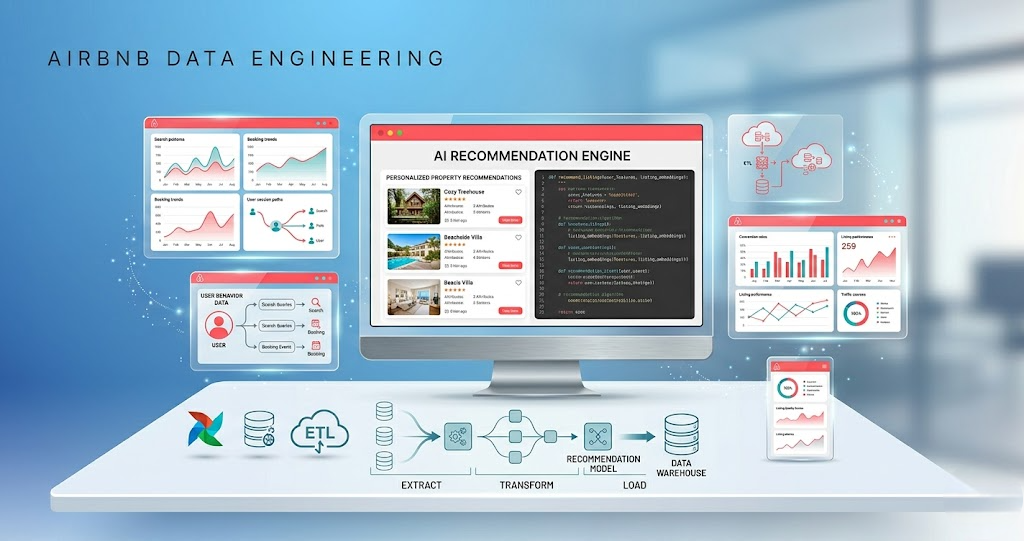
Modern applications like Airbnb handle massive amounts of user data every day. Millions of people search for hotels, apartments, vacation homes, and travel experiences across different locations worldwide.
To provide better user experiences, Airbnb uses advanced data engineering systems that process and analyze user activity continuously.
In this article, we will understand how Airbnb uses data engineering for personalized recommendations and why data engineering plays a major role in modern recommendation systems.
Why Personalized Recommendations Are Important
When users open Airbnb, they expect to see relevant property suggestions based on their interests, budget, search history, and travel preferences.
Without personalization, users would spend more time searching manually.
Recommendation systems help improve:
- User experience
- Booking rates
- Customer engagement
- Platform performance
This is where large-scale data engineering becomes extremely important.
How Airbnb Collects User Data
Every action performed on Airbnb generates data events.
For example:
- Property searches
- Clicks
- Wishlists
- Booking history
- Reviews
- User location
- Pricing preferences
These events are collected continuously from websites and mobile applications.
The data is then processed using modern data engineering pipelines.
Real-Time Data Processing at Airbnb
Airbnb uses real-time data processing systems to analyze user activity instantly.
Streaming platforms and cloud-based pipelines help process millions of events every second.
When a user searches for a property in a particular city, recommendation systems immediately analyze:
- Search history
- Similar user behavior
- Property popularity
- Availability
- Seasonal trends
This helps Airbnb display highly relevant recommendations quickly.
Technologies Used in Airbnb Data Engineering
Large-scale platforms like Airbnb use modern cloud and big data technologies such as:
- Apache Spark
- Apache Kafka
- SQL
- Machine Learning Models
- Cloud Storage Systems
- Data Warehouses
These tools help process huge datasets efficiently and support personalized recommendation engines.
Cloud platforms also help scale infrastructure dynamically based on traffic demand.
Role of Machine Learning in Recommendations
Machine learning models help Airbnb understand user preferences more accurately.
The system continuously learns from user interactions and improves recommendations over time.
For example, if a user frequently searches for beachside properties, Airbnb may start prioritizing similar listings automatically.
This combination of machine learning and data engineering creates highly personalized user experiences.
Why Data Engineering Matters in Modern Apps
Recommendation systems require clean, fast, and scalable data pipelines.
Without strong data engineering infrastructure, companies cannot process user behavior efficiently.
Platforms like Airbnb depend heavily on data engineering to:
- Process real-time events
- Store large datasets
- Build analytics systems
- Train recommendation models
- Improve application performance
This makes data engineering one of the most important technologies behind modern digital platforms.
Airbnb uses modern data engineering systems to deliver personalized recommendations for millions of users worldwide.
By combining real-time processing, cloud platforms, machine learning, and scalable pipelines, Airbnb improves user experience and booking efficiency continuously.
As recommendation systems become more advanced in 2026, data engineering skills will remain highly valuable for building intelligent applications and large-scale digital platforms.