
Modern companies generate massive amounts of data every day from applications, websites, cloud systems, IoT devices, and streaming platforms. To process and analyze this data efficiently, organizations use modern cloud data platforms like Snowflake and Databricks.
Both platforms are highly popular in the data engineering industry and are widely used by enterprises worldwide.
In this article, we will understand the differences between Snowflake and Databricks, their features, use cases, and which platform is better for data engineers in 2026.
What Is Snowflake?
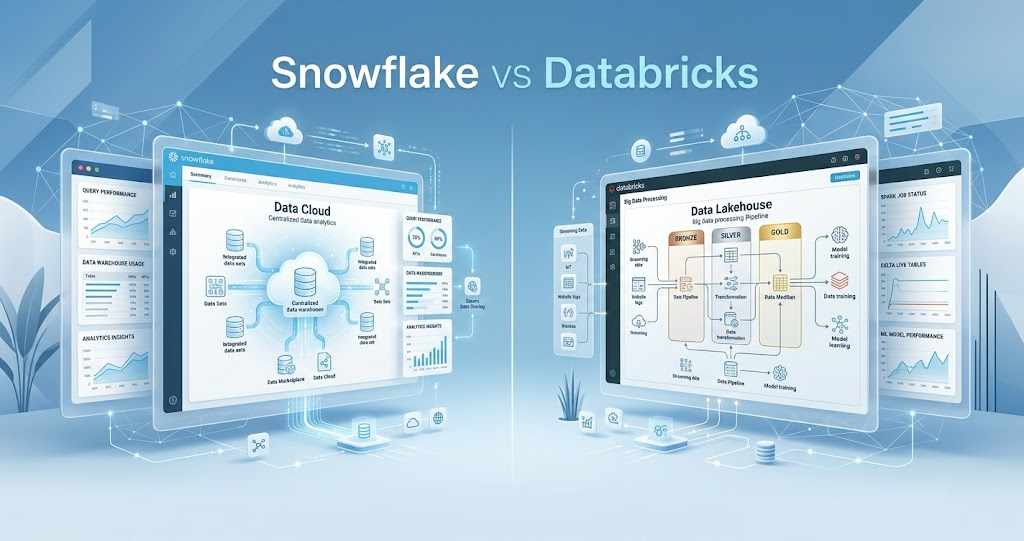
Snowflake is a cloud-based data warehouse platform designed mainly for data storage, SQL analytics, and business intelligence workloads.
It allows companies to store structured and semi-structured data in a scalable cloud environment.
Snowflake is known for:
- Easy SQL-based analytics
- High scalability
- Cloud-native architecture
- Fast query performance
- Data sharing capabilities
Many organizations use Snowflake for reporting, dashboards, and large-scale business analytics.
What Is Databricks?
Databricks is a cloud-based data engineering and analytics platform built around Apache Spark.
It is mainly used for:
- Big data processing
- Machine learning
- Real-time streaming
- ETL pipelines
- AI workloads
Databricks supports multiple programming languages such as Python, SQL, Scala, and R.
It is highly popular among data engineers, machine learning engineers, and data scientists.
Snowflake vs Databricks – Major Differences
Snowflake mainly focuses on data warehousing and analytics.
Databricks focuses more on big data engineering, machine learning, and advanced data processing.
Snowflake is easier for SQL users and business analytics teams because it requires less infrastructure management.
Databricks is more powerful for handling large-scale ETL pipelines, streaming systems, and AI-driven workloads.
Another major difference is processing architecture.
Snowflake uses cloud-native storage and compute separation, while Databricks uses Apache Spark-based distributed processing.
Which Platform Is Better for Data Engineers?
The answer depends on project requirements.
If the company mainly needs:
- SQL analytics
- Reporting dashboards
- Cloud data warehousing
- Business intelligence
then Snowflake becomes a strong choice.
If the organization handles:
- Real-time streaming
- Large-scale ETL pipelines
- Machine learning
- Big data processing
then Databricks is usually more suitable.
Many modern enterprises now use both platforms together.
Why Both Platforms Are Trending in 2026
As cloud adoption grows rapidly, companies need scalable platforms capable of handling massive datasets efficiently.
Snowflake simplifies cloud analytics, while Databricks supports advanced engineering and AI workloads.
This combination makes both platforms highly valuable in modern data engineering ecosystems.
Learning Snowflake and Databricks can provide excellent career opportunities for aspiring data engineers in 2026.
Snowflake and Databricks are two of the most important platforms in modern data engineering.
Snowflake is highly effective for cloud analytics and business intelligence, while Databricks excels in big data processing, machine learning, and real-time engineering workloads.
For data engineers, understanding both platforms can create strong career growth opportunities in cloud and big data technologies.