
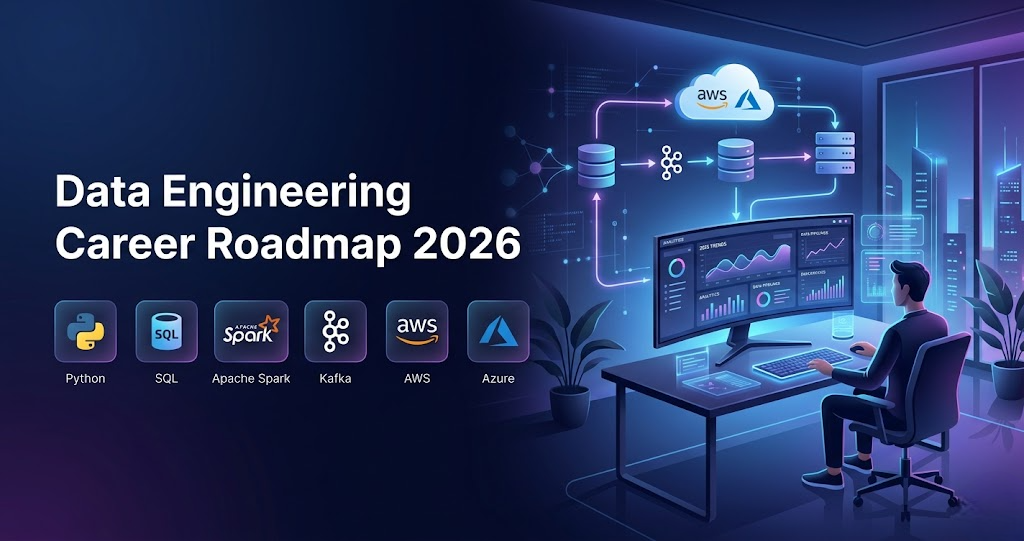
Data engineering has become one of the fastest-growing careers in the technology industry. As companies generate massive amounts of data every day, the demand for skilled data engineers is increasing rapidly across the world.
From Netflix and Amazon to banking systems, healthcare platforms, and AI companies, almost every organization depends on data pipelines, cloud systems, and real-time analytics. This is why data engineering is becoming one of the highest-paying and most future-proof careers in 2026.
If you are planning to start your journey in data engineering but feel confused about what to learn, this roadmap will help you understand the skills, tools, and projects required to become a successful data engineer.
What Does a Data Engineer Do?
A data engineer builds systems that collect, process, store, and transform data efficiently.
Data engineers are responsible for creating data pipelines that move data from multiple sources into databases, cloud platforms, and analytics systems. Their work helps data analysts, data scientists, and business teams access clean and reliable data.
Modern data engineers also work with big data technologies, cloud platforms, streaming systems, and real-time processing tools.
Why Data Engineering Is a High-Demand Career
In 2026, businesses are handling larger amounts of data than ever before. Companies need professionals who can build scalable systems capable of processing millions of records efficiently.
The rise of AI, machine learning, cloud computing, and real-time analytics has increased the demand for data engineers globally.
Many companies now prioritize hiring data engineers because data-driven decision-making has become essential for business growth.
Data engineering also offers:
- High salary packages
- Strong job opportunities
- Remote work options
- Global demand
- Long-term career growth
Step 1: Learn SQL Properly
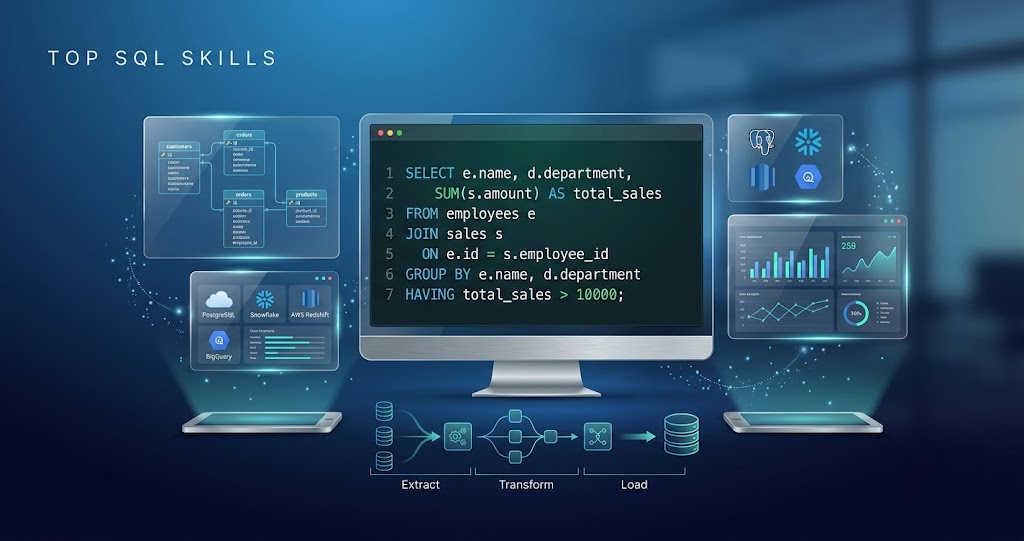
SQL is one of the most important skills for every data engineer.
Most company data is stored inside relational databases, and SQL is used to query, transform, and manage that data.
A beginner should focus on learning:
- SELECT queries
- JOINs
- GROUP BY
- Window functions
- Subqueries
- CTEs
- Query optimization
Strong SQL knowledge is mandatory before moving to advanced big data tools.
Step 2: Learn Python for Data Engineering
Python is widely used in data engineering because it is simple, powerful, and supports automation.
Data engineers use Python for:
- Data transformation
- ETL pipelines
- API integrations
- Data cleaning
- Automation scripts
- Workflow orchestration
Popular Python libraries include Pandas, PySpark, Requests, and SQLAlchemy.
A beginner should practice writing clean and efficient Python code regularly.
Step 3: Understand Databases
A data engineer must understand how databases work.
You should learn both:
Relational Databases
Examples include:
- MySQL
- PostgreSQL
- SQL Server
These databases store structured data.
NoSQL Databases
Examples include:
- MongoDB
- Cassandra
- DynamoDB
These databases handle large-scale and flexible data systems.
Understanding indexing, partitioning, and database optimization is very important.
Step 4: Learn ETL and Data Pipelines
ETL stands for Extract, Transform, and Load.
This is the core process used in data engineering.
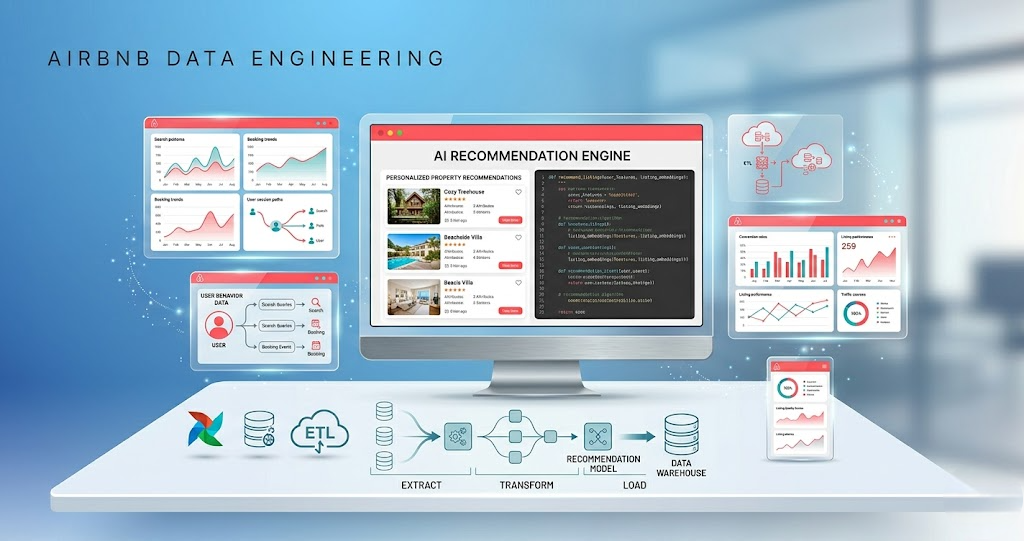
Data engineers extract data from multiple systems, transform it into usable formats, and load it into warehouses or analytics platforms.
You should understand:
- Batch processing
- Real-time processing
- Workflow automation
- Scheduling systems
- Data quality checks
ETL pipelines are used in almost every data engineering project.
Step 5: Learn Big Data Technologies
As data volume grows, companies use distributed systems to process large datasets efficiently.
Apache Spark is one of the most important big data technologies in 2026.
Spark is used for:
- Large-scale data processing
- Streaming analytics
- Data transformations
- Machine learning workflows
You should also understand:
- Hadoop basics
- Spark DataFrames
- Spark SQL
- PySpark
Big data technologies are widely used in enterprise environments.
Step 6: Learn Cloud Platforms
Cloud computing has become a major part of modern data engineering.
Most companies now use cloud platforms instead of traditional on-premise systems.
The most popular cloud platforms are:
- AWS
- Microsoft Azure
- Google Cloud Platform (GCP)
A beginner should focus on learning cloud storage, data warehouses, and data processing services.
Important tools include:
- AWS S3
- AWS Glue
- Azure Data Factory
- BigQuery
- Snowflake
- Databricks
Cloud skills are highly valuable in the job market.
Step 7: Learn Real-Time Data Processing
Modern applications process streaming data continuously.
Companies like Uber, Netflix, Swiggy, and Amazon depend heavily on real-time data systems.
This is why learning streaming technologies is becoming important for modern data engineers.
Key technologies include:
- Apache Kafka
- Spark Streaming
- Apache Flink
These tools help process live events with low latency.
Step 8: Learn Data Warehousing Concepts
Data warehouses store processed business data for reporting and analytics.
A data engineer should understand:
- Star schema
- Snowflake schema
- Fact and dimension tables
- Partitioning
- Data modeling
Popular cloud warehouses include Snowflake, Redshift, and BigQuery.
Step 9: Build Real Projects
Projects are one of the most important parts of learning data engineering.
Companies want practical experience, not only theoretical knowledge.
Beginners should build projects such as:
- ETL pipeline using Python and SQL
- Real-time streaming pipeline with Kafka
- Data warehouse project using Snowflake
- Spark data transformation project
- Cloud-based analytics pipeline
Projects help improve practical understanding and strengthen resumes.
Step 10: Learn Workflow Orchestration Tools
Large data pipelines need automation and scheduling systems.
Apache Airflow is one of the most widely used orchestration tools.
Airflow helps schedule, monitor, and manage workflows efficiently.
Data engineers use orchestration tools to automate production pipelines.
Important Tools Every Data Engineer Should Know
In 2026, these tools are highly valuable:
- SQL
- Python
- Apache Spark
- Kafka
- Databricks
- Snowflake
- AWS
- Azure Data Factory
- Airflow
- Git
You do not need to master everything at once. Start step by step.
Common Mistakes Beginners Make
Many beginners try to learn too many tools together without understanding the basics.
Some focus only on watching tutorials without building projects. Others skip SQL and directly jump into cloud platforms or Spark.
A better approach is:
- Learn fundamentals first
- Practice regularly
- Build projects
- Learn cloud technologies gradually
- Focus on consistency
Data engineering takes time, but regular practice brings strong results.
Future of Data Engineering
The future of data engineering looks extremely strong.
As AI systems continue to grow, companies will require even larger data infrastructure and real-time processing systems.
Technologies like cloud computing, streaming analytics, and AI-powered pipelines will continue creating new opportunities for skilled data engineers.
This makes data engineering one of the safest and most promising careers for the future.
Data engineering is not only about learning tools. It is about understanding how modern data systems work and solving real business problems using scalable technologies.
If you follow a structured roadmap, practice consistently, and build real projects, you can become a successful data engineer in 2026.
Start with SQL and Python, gradually move toward cloud and big data technologies, and focus on hands-on learning instead of only theory.
The demand for skilled data engineers is growing rapidly, and this is one of the best times to start your journey in the data engineering field.