
Data Quality Checks in Data Engineering – Rules, Examples
Introduction
Trying to understand data quality checks in data engineering but not sure what actually needs to be checked?
You’re not alone.
Most people:
- Learn ETL pipelines
- Learn tools like Spark and Glue
- Focus on processing
But ignore data quality.
And in real projects, bad data is a bigger problem than slow pipelines.
Because processing wrong data gives wrong results.
In this blog, you’ll understand:
- What data quality checks are
- Why they are important
- Types of checks used in real pipelines
- Where they fit in data engineering
Data quality checks are validations applied to data to ensure it is correct, complete, and reliable before processing or analytics.
Why Data Quality Checks are Important
- Prevent incorrect data
- Avoid wrong business decisions
- Maintain data consistency
- Improve pipeline reliability
Without data quality checks, pipelines produce invalid results.
Where Data Quality Checks Happen
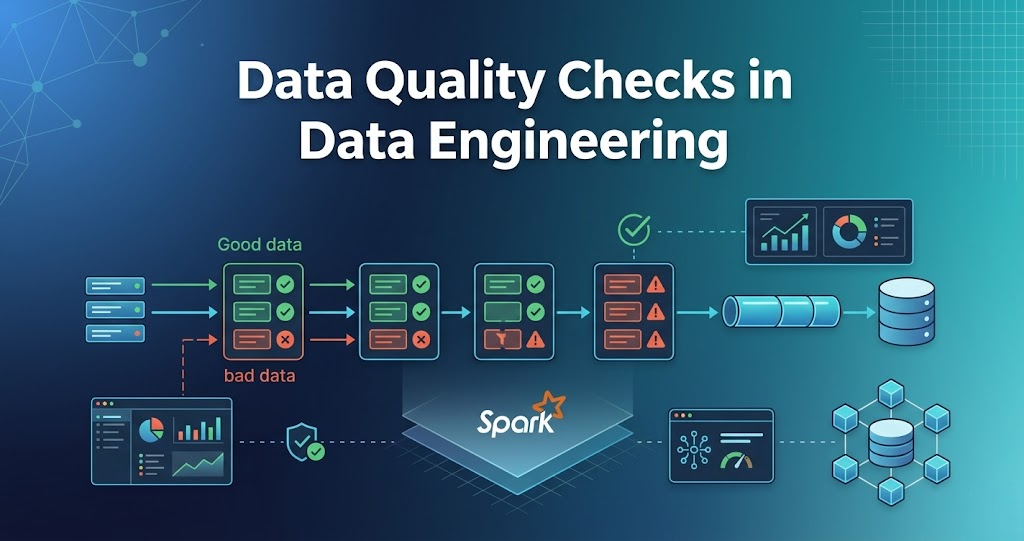
In real pipelines, checks happen at multiple stages:
- Ingestion layer
- Processing layer
- Before loading into warehouse
Step 1: Schema Validation
Check if data matches expected structure.
Examples:
- Column names
- Data types
- Missing columns
If schema is wrong, pipeline should fail.
Step 2: Null Checks
Check for missing values.
Examples:
- id should not be null
- important fields should not be empty
Null values can break downstream processing.
Step 3: Duplicate Checks
Check for duplicate records.
Examples:
- Duplicate transactions
- Duplicate customer IDs
Duplicates create wrong analytics.
Step 4: Data Type Validation
Check if data types are correct.
Examples:
- Date column should be date
- Amount should be numeric
Wrong data types cause errors.
Step 5: Range Checks
Check if values fall within valid range.
Examples:
- Age should not be negative
- Salary should be within expected range
Step 6: Business Rule Validation
Check based on business logic.
Examples:
- Order amount should be greater than zero
- Status values should be valid
This ensures data correctness.
Step 7: Consistency Checks
Check data consistency across datasets.
Examples:
- Customer ID exists in master table
- Foreign key validation
Step 8: Data Freshness Check
Check if data is up to date.
Examples:
- Daily data should be available
- No missing partitions
Step 9: Record Count Validation
Check number of records.
Examples:
- Source vs target count
- Sudden drop in data
Helps detect data loss.
Step 10: Format Validation
Check data format.
Examples:
- Email format
- Date format
How Data Quality Checks Fit in Pipeline
Typical flow:
- Data ingested from source
- Schema validation
- Apply data quality checks
- Clean and transform data
- Load into storage
- Validate before analytics
Real-World Example
E-commerce pipeline:
- Orders data ingested
- Null checks applied
- Duplicate records removed
- Business rules validated
- Clean data stored
- Used for reporting
Common Mistakes
- Ignoring data quality
- Not failing pipeline on errors
- Not validating schema
- Checking only after processing